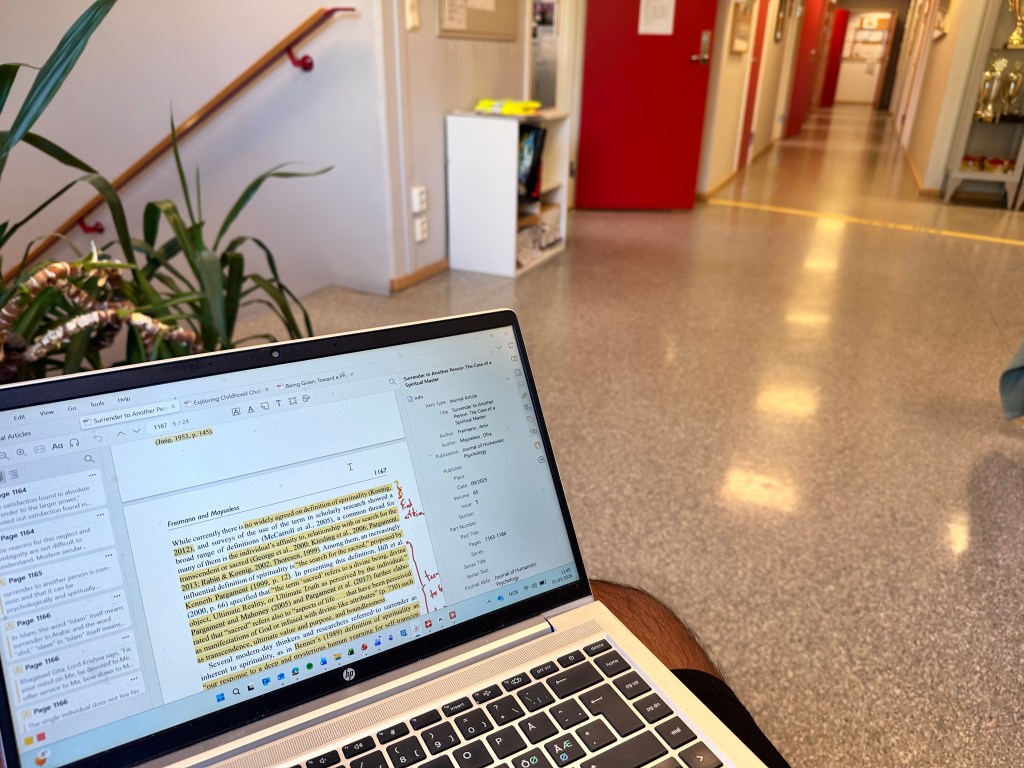
I am sitting in the teachers’ lounge of my son’s new school, doing my literature review.
Let me say that again, because it sounds absurd even to me. I am thirty-something pages into a Norwegian study on existential loneliness, with seventeen tabs open in Obsidian, Zotero quietly humming alongside it, and a living document I lovingly call my kale document — because I just keep stuffing things into it, the way you stuff kale into a smoothie hoping it will eventually become nourishment — and I am doing all of this surrounded by primary school teachers’ coffee mugs.
I’m here because my ten-year-old asked me to be.
Not in those words. He doesn’t really ask in those words. But the deal we’ve struck, after two years of homeschooling and a careful return to a classroom one day a week, is that I’m in the building. Upstairs. Somewhere he can find me if he needs to. He almost never does. Today I had to sneak out for a doctor’s appointment and spent the entire thing watching the clock, calculating the walk back, in case he popped his head into the lounge and found me missing. He didn’t. But I needed him to be able to.
This is the shape my PhD is taking right now.
It’s not the shape I imagined. I imagined libraries. The research centre. Long, uninterrupted stretches with my colleagues, whiteboard markers in hand, the kind of conversations where you lose track of the afternoon. There is a version of this PhD that lives in those rooms, and it’s a perfectly good version. It just isn’t mine.
Mine lives in a teachers’ lounge. With a thermos. And a son three classrooms away.
The PhD itself is on men, spirituality, and existential health. More specifically, it’s about men’s groups — five of them, scattered across Norway, India, and Costa Rica (which is, in fact, why we were down there a little while ago — that whole episode with the missing luggage and the sleepless first 48 hours was the family-shaped wrapper around what was, for me, fieldwork) — and how participating in spiritual practice in the company of other men shapes the way they navigate the deepest questions: meaning, isolation, mortality, what to do with the freedom we didn’t ask for. It’s a question that has been with me, in one form or another, for as long as I can remember. My father, before he was my father, was a Catholic priest. He left the priesthood, but he never left the question. What he passed to me wasn’t a doctrine; it was a relationship — his with God, and eventually mine with whatever I might come to call by that name. My mother passed something quieter and parallel: karma yoga, the art of being in service. Two traditions, two parents, and somewhere in the space between them, a child wondering what holds a man together when the surfaces of life stop holding.
I am still that child. The PhD is just the grown-up form of the question.
What I didn’t expect — what I am still adjusting to — is how much of my literature review I would do in a teachers’ lounge while my son draws fractions in the next building over.
I am, at this exact moment, in what I can only describe as 67-mode.
The 6-or-7 thing has lodged itself in our family vocabulary in a way I cannot dislodge. We’re going to bed in 6 or 7 minutes. Let me sit for 6, 7 minutes before I get back on the trampoline. I think I’ll need 6 or 7 tomatoes for the sauce.When the kids are being difficult, I now reply to everything in 6-7 just because I can, and because somewhere inside me a small, unserious part of me has decided this is the appropriate response to chaos. Thank you, internet. Thank you, kids. The damage is done.
But here in the lounge, 67 has stopped being a joke. It’s the literal number of things in my head. Sixty-seven open questions, half-read PDFs, half-formed ideas, citations I haven’t yet chased, methodological choices I haven’t yet made, theorists I keep meaning to circle back to. Yalom is sitting next to Hartmut Rosa, who is sitting next to a paper on existential loneliness in young men, which is sitting next to an Indigenous framework of four worlds, which is sitting next to a quote from Marcel about the difference between a problem and a mystery.
And that’s just the literature. Sitting alongside it, in their own messy stack, are my fieldwork notes from Costa Rica and the transcribed interviews from the men I spoke with there — waiting to be coded. Coded. The word itself sounds clean and orderly, like something you do with a cup of coffee and a quiet hour. In practice, it is none of those things. (Aside to any qualitative researchers reading this who actually love coding and have figured out a humane way to do it: please, for the love of all that is good, give me a holler.)
Somewhere underneath all of it is the actual writing I have not yet started, because how do you start when you have not yet read enough? And how do you know when you have read enough? Nobody tells you. Nobody ever told me. I keep waiting for the moment when something audible happens, like a bell, like a chime, like a now. So far, only silence. And another database. And another.
This is the part of the PhD they don’t really warn you about. Or maybe they do, and you don’t believe them, the way you don’t believe people who tell you what new fatherhood is like.
There is something I notice, though, sitting here.
I am writing about men in spiritual community. About what it means for a man to belong to something larger than his own striving. About how the deepest existential struggles — what Yalom called the four givens, what Marcel called mystery, what my father might simply have called the things you can’t reason your way through — are not, in fact, things we are meant to face alone.
And I am writing about it from a lonely posture. One man, one laptop, in a quiet room, drowning in 67 things, while the people I love most are scattered through the building or across town.
The irony isn’t lost on me. But it’s not really irony, either. Because the men I sat with in Costa Rica — and the men I’ll sit with later this year in Vrindavan, and in the Sufi circle in Oslo, and in the Buddhist circle in Nesodden, and in the Christian men’s group through the Philadelphia church — I suspect a lot of them will tell me, in their own way, something I already half-know: that the spiritual question for a man, at a certain point in his life, stops being abstract. It becomes a question about his marriage. His kids. The hours of his day. Whether he can be present to the people in front of him without splitting himself into pieces. I have friends whose spiritual lives only began to feel real once they got tangled up with their families. I have friends who feel, in their bones, that something is missing from their fatherhood and can’t quite name what. The literature speaks to all of this, in its careful, footnoted way. So does my life, much less carefully.
The PhD topic and the lounge are not two different things. They keep insisting on being one.
People sometimes ask me where I do my best thinking, and I used to be embarrassed by the answer.
I don’t think well in the research centre. I love my colleagues. I love the conversations. But the thinking — the slow, sideways, generative thinking that eventually becomes a paragraph worth keeping — happens in stranger places. In the car on the way back from dropping a kid somewhere. In the kitchen, mid-sauce, with 6 or 7 tomatoes on the cutting board. And lately, it happens here. In the teachers’ lounge. With the muffled sound of a music class drifting up through the floor, and a marble run going on somewhere in my head, the way it has been going on in his head for almost his entire life.
It feels — oddly — like the right place to be.
I can’t fully explain that. I am a serious academic, allegedly, embarked on a serious project, and I am writing it from a borrowed chair in a primary school. But I think what I’m slowly understanding is that this isn’t a compromise. It isn’t the lesser version. It isn’t the PhD I would do if only my circumstances were different. My circumstances are the PhD, in some quiet way I haven’t fully worked out yet. The man who is researching how other men find meaning is, himself, a man trying to find meaning in the middle of his own life — not after it, not before it, in it.
The literature review will get done. The 67 things will, eventually, become an outline, then a draft, then three articles, then a thesis. Or they won’t, and I’ll have to figure out something else, the way you figure out everything else. Either way, my son will pop his head in at some point, see me at this desk, give me a small thumbs up, and disappear back down the corridor. And that — for reasons I am only beginning to understand — is doing something for both of us that no library could.
The mystery, as Marcel said, is the kind of thing you can’t solve. You can only live it through.
I think I’m doing that now.
In 6 or 7 minutes, I’ll close the laptop and go check on him.


Leave a Reply