In a few hours, my oldest (currently 10) walks into a new school for the first time in two years.
Two hours. A teacher. A classroom. Nothing dramatic, just a boy and a room and a quiet experiment. But I’m up early, unable to fully settle, turning the last two years over in my mind. How we got here. What we gave up. What we found.
It didn’t start as a decision. It started as a slow drip.
My oldest had been struggling. Not dramatically, not all at once, but persistently, in ways that didn’t fit neatly into any explanation the schools offered. We tried different settings, different pedagogical approaches. We shifted and adapted and hoped. And through it all, the thing that my wife and I kept noticing was his stress. Not the passing anxiety of a hard day. Something more constant. Something too large for a child his age. But we, as frantic parents of a modern age, chalked it up to school nerves. Tried to “normalize it” in our own minds, silently.
We had friends who homeschooled. My wife and I used to talk about them with a mixture of admiration and dismissal. Good for them, we thought. But we gotta work. That was our line. We had lives, careers, ambitions. Homeschooling was for other kinds of families.
Then after many, many meetings and discussions with teachers, principles, health workers (this might take the form of another post later) BUP — the Norwegian child psychological health unit — encouraged us to take matters into our own hands.
We became that other kind of family.
What followed was a renegotiation of almost everything.
I tried to make it work the conventional way first: tech sales, remote work, something that would let me stay close to home while keeping the income steady. I’d done it before. I figured I could do it again. But the job wanted what jobs like that always want: full presence, constant availability, the particular kind of grinding forward motion that has nothing to do with a child who needs his father nearby. I tried to justify it to myself. I tried for a while. But there’s a particular exhaustion that comes from lying to yourself about your own values, and eventually I couldn’t keep it up.
I think about a night from earlier, before all this, way back when I was in corporate sales, before we’d really understood what my oldest needed. I walked through the front door at 6:30pm and my wife met me at the entrance. She had him in her arms. She looked at me. And she just said here and placed him in my hands and walked away. Not out of cruelty. Out of complete depletion. That stayed with me. That’s what we were building toward, if we stayed on that road.
So we took the detour.
We restructured. We got creative. Rental income. A section of our property for gatherings. Airbnb when we could manage it. We both leaned harder into our research — my wife is further along her PhD than I am, which gives her even more flexibility. We made the numbers work, not elegantly, but in a way that could work. And we built a life that has, at its center, one clear conviction: the kids come first. If something has to give, it isn’t them.
My oldest, in this new life, has become more himself.
That’s the only way I know how to say it. The stress that had settled into him like weather — it lifted. He’s happier. More confident. More him. He laughs easier. He takes up more space in a room, in the best way.
And his curiosity, which was always there, finally has room to run.
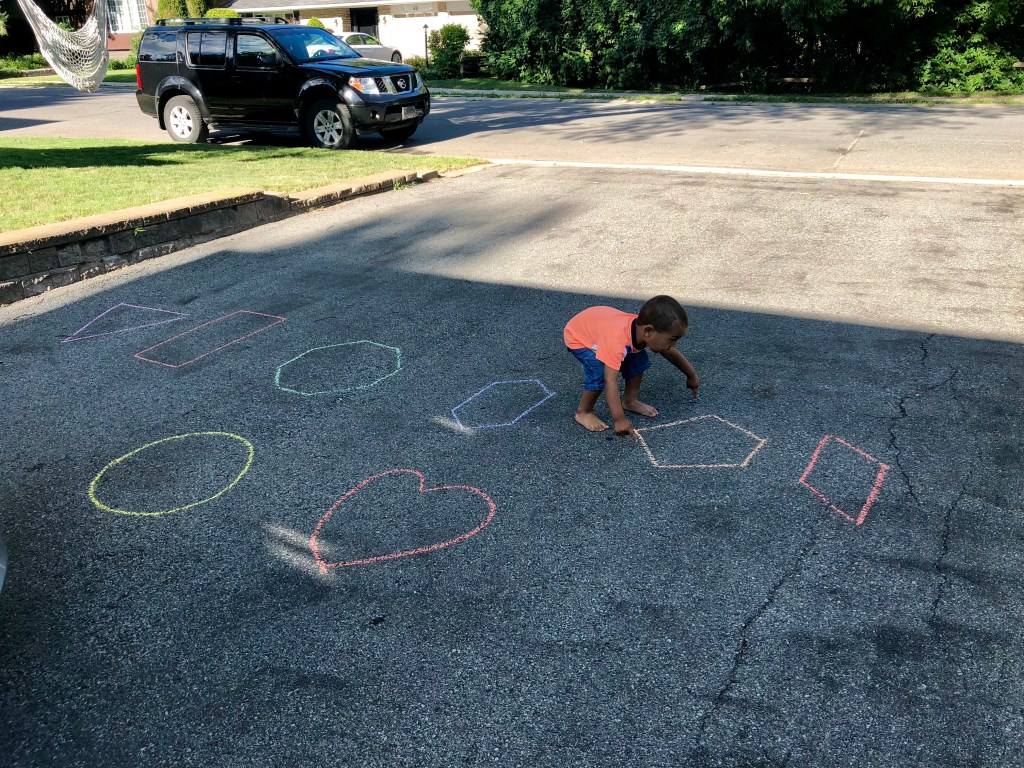
He’s been building marble runs since he was two or three — first a wooden German set (my god, so many add-on’s have followed) then Gravitrax, which he still uses today. His idea of a perfect afternoon is trance music and a marble run of his own invention, or sitting quietly with one of his mandala books. At two, he was naming galaxies. At three, he could walk around a chalk-drawn driveway and identify a dodecahedron. He loves ancient history. He loves fractions — not because he’s a prodigy at them, but because he enjoys the process, which I find more remarkable than any score ever could be.
Thanks to him, my wife and I went deep into the philosophy of education in a way we never would have otherwise. We read about the origins of schooling, about Steiner and Montessori, about what public school systems were designed to do and what they sometimes fail to do. He opened that door for us. He made us think harder than we expected to about what learning is actually for.
Which brings me to this week.
We had a meeting with a new school, a potential re-entry point, something gradual, something on his terms. And the principal herself asked us: What would make this easiest for him? Once a week to start? Come in late? Leave early?
I sat there and felt something loosen in my chest.
Because that’s not how it’s gone before. Before, it was show up like everyone else, stay for the day, he’ll be fine. The system presenting itself as the only reasonable container, and my oldest being asked to fit. And here was this woman (the principal, of all people!) asking us what he needs. Not telling us. Asking.
A human seeing a human.
I could have cried. I didn’t, but I could have.
In a few hours he goes in. A teacher will meet him. He’ll see a classroom. We’ll see how it feels.
I don’t know what comes next. I’m not sure we’re supposed to know. The last two years have taught me that the detour sometimes is the road, and that the life you end up building under pressure can be more honest than the one you planned.
What I do know is this: he’s okay. More than okay. And whatever today brings, we’ll meet it the same way we’ve tried to meet everything: together, flexibly, with him at the center.
Fingers crossed.


Leave a Reply